


What if the reason your AI outputs feel generic has nothing to do with the tool you picked, and everything to do with instructions you learned two years ago that no longer apply?
Prompting and model training are two completely different things, and mixing them up costs teams real time and money every single day. This guide is built for beginners, business teams, and developers who want a clear, current answer: what actually makes a prompt work in 2026, what has changed with newer reasoning models, and how do you fix the subtle mistakes that quietly ruin most AI output?
What Is the Difference Between Prompt Engineering and AI Model Training?
People throw around “training an AI” and “writing a prompt” like they’re the exact same activity. They aren’t, and this mix-up causes massive confusion.
Training a model means feeding it massive datasets so it can learn patterns, language structure, and general knowledge before you ever type a single word. This process permanently changes the model’s internal weights and parameters. It is incredibly expensive, slow, and handled entirely by the AI companies building the tech (like OpenAI, Anthropic, or Google)—not by you.
Prompting happens after training is completely done. You aren’t changing the model’s brain; you are simply steering it. Think of it like using natural language to point a fully educated expert toward the specific output you want.
Fine-tuning sits right in the middle. It’s a lighter, specialized version of training applied to an existing model, usually reserved for enterprise use cases where a company needs the AI to master a specific proprietary dataset or distinct brand voice.
Why You Cannot “Train” an LLM Using a Prompt
When someone asks how to “train AI with prompts,” what they usually mean is how to write prompts well enough that the model performs like it was custom-trained for their task.
Understanding this distinction changes everything. If you know you aren’t training the AI, you stop expecting a prompt to do things it physically cannot do. A prompt won’t teach a model brand-new world facts it never saw during training, and it won’t permanently change how that model responds to other people’s requests tomorrow. What it will do is dramatically shift the quality, tone, and usefulness of the specific answer you get right now.
What Common Prompting Mistakes Destroys AI Outputs?
Most people don’t fail at prompting because they lack talent. They fail because a handful of legacy habits quietly undercut their inputs.
1. The Vagueness Trap
Before (Weak): “Summarize this article.”
After (Optimized): “Summarize this article in 5 bullet points for a reader with no background in the topic. Focus exclusively on the main argument and one practical takeaway.”
The first version leaves length, depth, and audience completely undefined, forcing the model to guess. The second version removes every single piece of guesswork.
2. Overloading a Single Prompt
Asking a single prompt to plan a content strategy, generate ten titles, write a full article, and build a three-month social media calendar produces a rushed, shallow version of all four tasks. Breaking that into four sequential prompts—where the output of step one informs step two—produces vastly superior results and allows you to catch errors before they compound.
The Core Principles of Context, Specificity, and Role
While the underlying technology shifts, the fundamental mechanics of communication remain the same. These are the principles worth mastering before moving on to advanced strategies.
Context and Specificity Carry the Most Weight
Vague prompts get vague answers. That is an absolute law across every model, every platform, every time.
Assigning a Persona Shas it Sharper
Telling the model to act as a “senior copywriter,” a “customer support lead,” or a “financial analyst” shifts the vocabulary, depth, and structural choices of the response before generation even begins. This isn’t a gimmick. It is a highly efficient way to prime the model toward the exact professional register your task demands.
Format and Output Specification Are Non-Negotiable
Most disappointing AI outputs trace back to one missing instruction: nobody told the model what shape the answer should take. If you want bullet points, say so. If you want a Markdown table, explicitly ask for it. Models do not guess your preferred layout; they default to whatever is statistically common for that kind of request.
Do You Still Need “Think Step by Step” in 2026 & beyond?
This is the exact area where old prompting advice has quietly gone stale, and almost nobody has updated their guidance to reflect it.
| Model Category | Needs “Think Step by Step”? | Best Prompting Focus |
| Reasoning Models (GPT-5/o-series, Claude Opus, Gemini Pro) | Rarely. Can be redundant or hurt output. | Clear ultimate goals, strict constraints, explicit output formatting. |
| Lightweight / Fast Models (Mini, Flash, Turbo tiers) | Yes. Still highly effective. | Explicit chain-of-thought instructions, step-by-step guidance. |
| Image & Creative Models (Midjourney, DALL-E 3) | Not applicable. | Rich descriptive detail: artistic style, lighting, composition, tone. |
| Coding Assistants (Cursor, Copilot, specialized tools) | Highly model-dependent. | Breaking complex tasks into smaller, single-purpose modular prompts. |
How Do ChatGPT, Claude, and Gemini Handle Prompts Differly?
Treating every AI platform exactly the same leaves massive quality on the table. While core principles transfer, each major LLM has distinct structural preferences in 2026.
How to Use XML Tags for Advanced Prompting in Claude
Claude tends to follow literal instructions incredibly closely and responds exceptionally well to structural boundaries. If you don’t explicitly ask for something, Claude generally won’t assume it, making its outputs highly predictable once you adapt to its style.
The most effective way to prompt Claude is by using XML tags to separate your raw data from your core instructions:
<context>

[Insert your target audience data, background info, or brand guidelines here]

</context>
<instructions>
Based on the context provided above, write a brief announcement. Use a professional tone.
</instructions>
How to Write Positive Constraints for Google Gemini
Gemini has a tendency to over-index on heavy negative instructions. If you pepper your prompt with “don’t do X, don’t do Y, never mention Z,” Gemini can become overly restrictive, which occasionally degrades its core reasoning capabilities.
Instead of negative constraints, use positive framing. Tell the model exactly what to do:
Avoid: “Don’t write a boring, corporate intro.”
Use instead: “Start immediately with a bold, hook-driven opening sentence that focuses on a real-world problem.”
Optimization Strategies for GPT-Based Tiers
GPT models are highly flexible across formats but benefit immensely from explicit output specifications. If you need GPT to feed data into another system or workflow, explicitly request structured formats like clean Markdown tables or strict JSON schemas. It is highly resilient at adhering to complex, programmatic data structures when explicitly commanded.
A Simple Framework Anyone Can Use: The Four-Part Formula
You do not need a computer science background or technical fluency to prompt at an elite level. You just need a repeatable, logical structure.

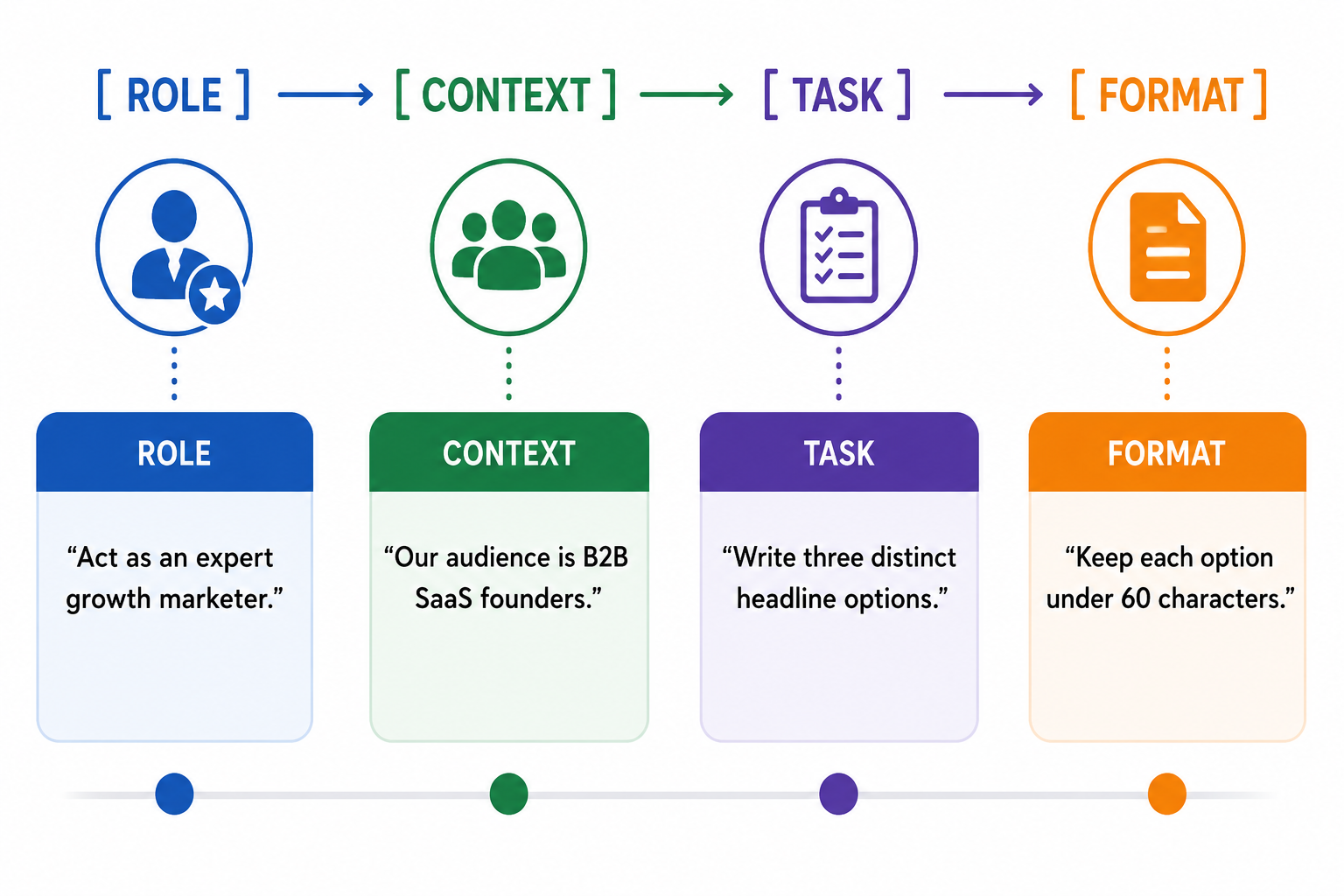
While not every quick query requires all four elements fully spelled out, complex or high-stakes business requests improve dramatically the moment you apply this workflow:
Role: Define who the AI should act as (setting the perspective and professional vocabulary).
Context: Provide the background information, target audience, or constraints the model actually needs to know.
Task: State the explicit, unambiguous action you want performed.
Format: Specify exactly how you want the output structured, including length, layout, and stylistic tone.
This shared framework is particularly powerful for cross-functional corporate teams. A marketing lead, an operations specialist, and a developer can all utilize the exact same four-part formula, ensuring prompt quality across an entire organization stops depending on who happens to be the most naturally “tech-savvy” person in the room.
The Master Checklist for High-Performing Prompts
Run through this quick mental checklist before hitting enter on any prompt that directly impacts your work quality.
BEFORE YOU PROMPT:
[ ] Goal defined: What does an absolute “home run” answer look like?
[ ] Audience specified: Who is the ultimate end-user of this content?
[ ] Format stated: Did I explicitly ask for bullets, paragraphs, a table, or JSON?
[ ] Constraints listed: Have I defined length, tone, scope, and specific exclusions?
[ ] Examples included: If the task is subjective or highly creative, did I provide a few gold-standard examples for the model to emulate?
AFTER THE FIRST RESPONSE:
[ ] Review against the goal: Did the AI actually answer the core prompt, or did it just sound good?
[ ] Refine the boundaries: What context did I accidentally leave out that caused it to drift? Add it and retry.
[ ] Deconstruct if overloaded: Did the response turn out messy because I asked for too many things at once? Break it into sequential steps.
[ ] Save the winner: Did this prompt perform flawlessly? Save it to a shared team library for seamless reuse.
What Tools Are Used for Prompt Optimization and Management
Prompting has officially evolved beyond chaotic copy-pasting from messy Google Docs. In 2026, professional teams and organizations look at prompt management as an operational discipline.
Model Provider Playgrounds: Serious optimization happens in environments like the OpenAI Playground or Anthropic Console. These sandboxes allow you to adjust system instructions, test system temperatures (controlling creativity vs. predictability), and test variants side-by-side.
Version-Controlled Prompt Registries: Modern teams treat prompts like code. Tools that allow version control ensure that when a model gets updated by its provider, teams can quickly update, test, and deploy modified prompt templates across their software applications without breaking active workflows.
A/B Testing Frameworks: Evaluating prompt quality is shifting from subjective “vibe checks” to systematic testing, where multiple prompt variants are run against a static batch of 20-50 real-world customer inputs to see which version consistently yields the highest factual accuracy and brand alignment.
Building the Skill: Cost, Career Value, and Growth
Prompting well is increasingly recognized as a foundational professional skill, rather than just a background habit that enthusiastic AI users pick up on the side.
What Do Prompt Engineering Services Actually Cost ?
Businesses are increasingly eager to pay for individuals who can reliably extract elite output from AI systems. Freelance and consulting rates vary wildly based on specialization rather than hours logged.
Basic prompt cleanup, simple formatting adjustments, and single-platform content templates sit on the accessible end of the market. Conversely, building complex agentic workflows, multi-step automated prompt chains, and custom enterprise prompt systems designed to hook into existing company databases command premium project fees. Value is tied directly to efficiency—a well-built prompt architecture can save an enterprise thousands of operational hours long after the initial configuration is complete.
You Do Not Need a Paid Course to Master This
The single best piece of news is that building elite capability here does not require an expensive boot camp or a premium certificate. The absolute sharpest resources on earth are published entirely for free by the model providers themselves.
The official prompting documentation from Anthropic, OpenAI, and Google is consistently updated to reflect exactly how their latest models process tokens and manage context windows. Beyond documentation, active community forums and open-source practitioner breakdowns offer incredible real-world value.
The absolute fastest way to build the skill remains the least glamorous one: pick a highly repetitive, manual task you do every single week. Apply the four-part framework outlined above, test it across two different model tiers, and refine it over a dozen intentional iterations. That single, repeatable habit will build more practical, real-world AI fluency than passively watching a hundred hours of video courses.
If your organization is looking to move past generic AI outputs and build deep, repeatable internal fluency across your marketing, development, or operations workflows, Glaxit works directly with corporate teams to design practical, real-world AI strategies that actually hold up where it matters most: in production.
Frequently Asked Questions
What is the best way to train AI with prompts if I have no technical background?
Utilize the repeatable four-part formula: clearly establish a Role for the AI, provide rich structural Context, define the precise Task, and explicitly outline the expected output Format. This requires zero programming knowledge and works fluidly across all major LLM platforms.
How do you write a good AI prompt that gets useful results on the first try?
Eliminate all ambiguity. Explicitly detail your target audience, precise length constraints, required layout format, and contextual tone. Additionally, providing one or two clear examples of what a perfect output looks like will drastically increase first-shot accuracy.
Is prompt engineering still a useful skill now that AI models have gotten smarter?
Yes. Increased model intelligence translates to greater capability, not mind-reading. Smarter models still require precise context, deliberate boundaries, and clear constraints to deliver elite, hyper-specific results instead of technically correct but entirely generic answers.
Where can I find free resources to learn prompt engineering?
Look directly to the source. The official developer documentation and prompting guides published by OpenAI, Anthropic, and Google are world-class, completely free, and continuously updated to match active model performance.