

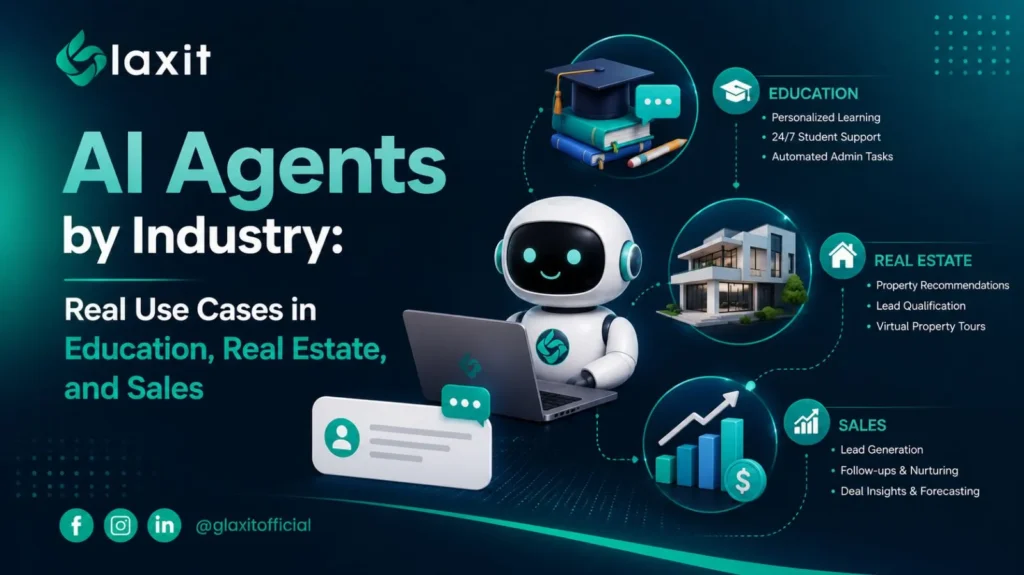
If you’ve been hearing “AI agents” everywhere and wondering what that actually means for your world, whether you’re a student, a home buyer, a sales rep, or just someone tired of hold music, this guide breaks it down by where these tools actually show up in daily life, including the actual products behind them.
An AI agent is different from a regular chatbot. It doesn’t just answer a question, it takes an action: booking a slot, checking a record, drafting a reply, or routing a call. That distinction matters, because it’s the difference between a tool that talks and a tool that does.
What Do AI Agents Do in Higher Education?
In schools, AI agents mostly help students get answers faster, things like admissions status, financial aid steps, or course scheduling, without waiting on hold or an email reply that takes days.
If you’ve applied to college recently, you may have already talked to one without realizing it. Platforms like Element451 and Druid AI power admissions chat and CRM systems behind the scenes at many schools, while tools built on advising-specific reasoning (some universities are testing systems along the lines of what researchers call neuro-symbolic advising agents) help check degree requirements and flag scheduling conflicts. Common ways schools use them:
- Admissions chat support that answers applicant questions any time of day, often through a CRM-integrated agent rather than a generic bot
- Financial aid triage, where an agent pulls a student’s file and explains next steps instead of routing them to a call queue
- Registrar and advising tasks, like checking degree progress or catching a scheduling conflict before it becomes a problem
- Faculty workflow support, including organizing course materials, often through general assistants like Claude or ChatGPT rather than education-specific products
The catch is oversight. A university agent touching student records has to follow FERPA rules, and most schools still keep final decisions on admissions, financial aid, and academic standing with a human. If a school’s agent gives you conflicting info, that’s a sign to go straight to a person, not to keep pushing the bot for a firmer answer.
How Are Real Estate Agents Using AI Tools?
Real estate professionals use AI agents mainly for lead qualification, listing descriptions, and scheduling, work that used to eat hours of an agent’s week.
If you’re house hunting, this might already be shaping your experience without you noticing. Agents commonly use general writing tools like ChatGPT or Claude for listing copy, CRM-based lead qualifiers like Follow Up Boss or Lofty to sort incoming buyer inquiries, and voice tools like Retell AI or Structurely to handle the first phone response to a new lead. A typical setup looks like:
- An agent-assisted system scans incoming inquiries and ranks them by how likely they are to close
- A drafting tool turns photos and property details into listing copy, cutting a task that took an hour down to minutes
- A voice or chat agent handles first-touch replies to buyer questions, then hands off to the human agent once a lead is warm
- A scheduling agent books showings directly on a calendar, checking availability without back-and-forth texts
Here’s the honest part: none of this replaces a good agent’s judgment. Pricing a home right, reading what a buyer actually wants, negotiating, that’s still a human skill. If an agent seems to respond instantly at odd hours, that’s often a tool doing the first pass, and that’s fine as long as a real person follows up once things get specific.
What Do AI Sales Agents Actually Do?
AI sales agents research prospects, draft outreach, and manage follow-up sequences, freeing sales reps to spend more time on actual conversations and closing.
You’ve probably interacted with the output of one, maybe without knowing it. Sales teams commonly use Clay (and its research agent, Claygent) for prospect research, tools like Artisan or Apollo for outbound drafting, and Salesforce Agentforce for teams already running their CRM inside Salesforce. Typical deployments include:
- Prospect research, where a tool like Claygent pulls company and contact details before a rep ever picks up the phone
- Outreach drafting, writing first-touch emails personalized to a specific account
- Pipeline follow-up, sending reminder sequences so no lead goes cold from neglect
- CRM updates, logging calls and notes automatically instead of relying on reps to do it manually
As someone on the receiving end, you can usually tell the difference between an AI-assisted message and a lazy one. The better sales teams use these tools to save time on research, then have an actual person write or edit the message that lands in your inbox. If a pitch feels robotic and impersonal, that’s a sign the human step got skipped, not that the tool itself failed.
Are AI Voice Agents Worth Using?
AI voice agents answer phone calls, route customer requests, and complete simple transactions using natural speech, and they work best on narrow, repeatable tasks.
You’ve probably talked to one already. Platforms like Retell AI, Synthflow, and PolyAI power a lot of the voice agents businesses use for customer calls, while enterprise platforms like Salesforce Agentforce Voice and Decagon handle voice inside larger support operations. Where voice agents show up most:
- Customer support lines, answering common questions and pulling account details without a hold queue
- Appointment booking, for clinics, salons, and service businesses that get high call volume
- Order taking, especially in restaurants and delivery services
- After-hours coverage, so a business doesn’t lose a lead just because it’s outside business hours
They’re genuinely useful for simple, predictable requests. Where they fall short is anything unusual or emotionally sensitive, like a billing dispute or a real complaint. If you feel like you’re stuck talking in circles, asking directly for a human agent usually works, and most systems are built to hand off when asked.
Comparison: Where AI Agents Show Up
| Industry | Main Task | Common Tools Behind It | What Still Needs a Human |
|---|---|---|---|
| Higher Education | Admissions & advising support | Element451, Druid AI, general assistants like Claude/ChatGPT | Complex financial aid or academic decisions |
| Real Estate | Lead scoring, listings, scheduling | Follow Up Boss, Lofty, Retell AI, ChatGPT/Claude for copy | Pricing, negotiation, reading buyer needs |
| Sales | Prospect research, outreach, follow-up | Clay/Claygent, Artisan, Apollo, Salesforce Agentforce | The actual pitch and closing conversation |
| Voice/Customer Service | Call routing, bookings, orders | Retell AI, Synthflow, PolyAI, Decagon | Disputes, complaints, anything unusual |
Frequently Asked Questions
Is it bad if I’m talking to an AI agent instead of a person?
Not necessarily. For simple, repetitive requests like checking a status or booking a time, an AI agent is often faster than waiting for a human. The concern is when something sensitive or complicated needs a real person’s judgment and you can’t get one.
Can I ask to speak to a human instead of an AI agent?
Usually, yes. Most companies and schools using these tools build in a way to escalate to a human, especially over the phone. If it’s not obvious, asking directly for “a person” or “a human agent” typically works.
What AI tools do real estate agents actually use?
Common ones include ChatGPT or Claude for writing listing descriptions, CRM platforms like Follow Up Boss or Lofty for lead management, and voice tools like Retell AI for handling initial call responses. Which combination an agent uses depends on their brokerage and budget.
Do AI agents in college admissions replace human counselors?
No. They handle repetitive questions like deadlines and document status, but most schools keep decisions about admission, aid, and academic standing with a human staff member.
Why do some sales emails feel like they were written by AI?
Because some are, at least the first draft, often through tools like Clay or Artisan. The better sales teams have a person review and personalize before sending. If a message feels generic or slightly off, that’s often a sign the human step was skipped.