

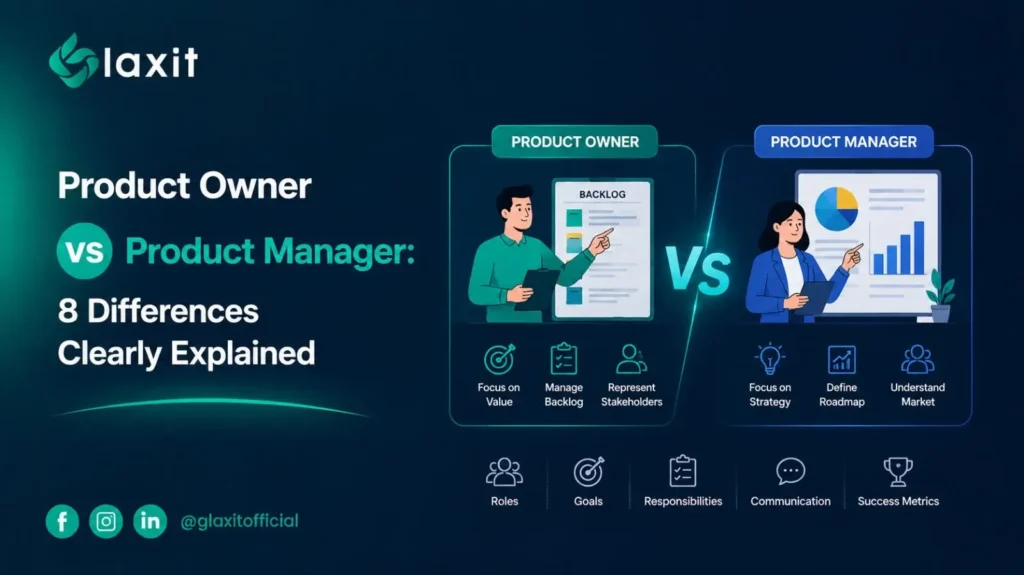
A product manager owns the overall vision, strategy, and business goals behind a product, while a product owner translates that vision into a prioritized backlog and guides the day-to-day work of an agile development team.
Anyone hiring for a product team, applying for a product role, or simply trying to figure out which title fits their skill set runs into this question fast. The confusion is real because the two roles overlap in agile methodologies, share tools, and sometimes even get filled by the same person at smaller companies. This guide breaks down the actual role differences, walks through responsibilities on both sides, and gives you a clear way to decide which role your team needs first.
What Is the Core Difference Between a Product Owner and a Product Manager?
A product manager works across the entire product lifecycle, from market analysis to business goals to long-term strategy, while a product owner focuses on execution inside a specific scrum team.
Think of it as strategic versus tactical. A product manager might spend a week studying customer research, competitor positioning, and revenue targets before deciding on a direction. A product owner takes that direction and turns it into sprint-ready user stories the same week.
- Product manager: owns the “why” and the “what” at a company level
- Product owner: owns the “how” and the “when” at a team level
They just sit at different points in the same process.
What Does a Product Manager Actually Do?
A product manager is responsible for vision and strategy, market analysis, and long-term roadmap development, connecting business goals to what the product actually becomes. They spend most of their time talking to leadership, studying the market, and deciding which problems are worth solving.
A typical week for a product manager includes reviewing competitor moves, analyzing usage data, and defending the roadmap in front of executives. They own decision making around what gets built over the next quarter or year, not just the next sprint.
Core responsibilities usually include:
- Setting product vision and strategy for the next 6 to 18 months
- Running market analysis and competitive research
- Aligning the roadmap with business goals and revenue targets
- Presenting product direction to executives and stakeholders
- Deciding which markets, segments, or use cases to prioritize
Product managers also need real technical understanding, not to write code, but to have honest conversations with engineering about what is actually feasible in a given timeframe.
What Does a Product Owner Actually Do?
A product owner manages the backlog, applies prioritization techniques inside each sprint, and works directly with the development team to keep agile methodologies moving smoothly. They are the person the engineering team goes to when a requirement is unclear.
Where a product manager thinks in quarters, a product owner thinks in sprints. Their job is turning strategy into a sequence of concrete, buildable tasks.
Common product owner tasks include:
- Writing and refining user stories with clear acceptance criteria
- Running backlog grooming and sprint planning sessions
- Prioritizing tasks based on value, effort, and dependencies
- Acting as the point of contact for developer questions during a sprint
- Reviewing completed work against the original requirements
Product owners live inside team collaboration. They are in daily standups, sprint reviews, and retrospectives far more often than product managers are.
Product Owner vs Product Manager
| Aspect | Product Manager | Product Owner |
|---|---|---|
| Primary focus | Strategy and long-term vision | Execution and backlog management |
| Time horizon | Quarters to years | Days to sprints |
| Key skill | Market analysis, business goals | Prioritization techniques, agile methodologies |
| Main stakeholder | Executives, customers, sales | Development team, scrum master |
| Decision scope | What to build and why | What to build next and in what order |
| Success metric | Revenue, market share, adoption | Sprint velocity, story completion, backlog health |
| Reports to | VP of Product or CPO | Product manager or head of product |
| Common background | Business, strategy, marketing | Engineering, analyst, scrum team member |
This table captures the six areas that come up most often when people search for role differences between the two positions: scope, decisions, skills, goals, roles, and responsibilities.
How Do These Roles Work Together in Agile Teams?
In most agile methodologies, the product manager sets direction while the product owner executes it, and the two roles depend on constant stakeholder communication to stay aligned. Without that communication, teams end up building the wrong thing efficiently.
A healthy setup looks like this: the product manager brings quarterly priorities into planning, and the product owner breaks those priorities into a backlog the team can actually work through. When customer feedback shifts mid-sprint, the product owner flags it, and the product manager decides whether it changes the bigger roadmap.
Team collaboration works best when both roles respect the boundary. Product managers who micromanage sprints frustrate the development team. Product owners who ignore the broader business goals end up shipping features nobody asked for.
Who Handles Customer Focus and User Experience?
Both roles touch customer focus and user experience, but a product manager gathers insight through customer interviews and market research, while a product owner validates it through what actually ships. They are two ends of the same feedback loop.
A product manager might run 20 customer interviews before writing a single line of a roadmap. That research shapes the user experience goals for the next release. The product owner then makes sure the team builds features that hold up against those goals, story by story, sprint by sprint.
This is why user research tools and customer feedback platforms often get used by both roles, just for different purposes. One uses it to decide direction, the other uses it to validate execution.
Who Actually Makes the Final Decisions?
A product manager typically holds final decision making authority on business goals and product direction, while a product owner has final say on backlog order and sprint scope. Neither one overrides the other’s domain without a real conversation.
This split avoids two common failure modes. It stops product managers from getting pulled into sprint-level arguments about story points, and it stops product owners from getting stuck making company-level bets they were never hired to make.
At smaller companies, this line blurs fast, which brings up the next question a lot of people ask.
Can One Person Be Both a Product Owner and a Product Manager?
Yes, and it happens often at startups and smaller teams where hiring two separate roles does not make financial sense yet. The challenge is context switching between strategic thinking and tactical execution, which both demand real focus.
Someone doing both jobs usually spends mornings on strategy work like market analysis and roadmap development, then shifts into backlog grooming and standups in the afternoon. It works, but it rarely scales past one or two product lines before something starts to slip.
Which Role Should a Startup Hire First?
Early-stage startups usually need a product manager first, because someone has to decide what to build before there is a backlog worth managing. Once the team grows past 5 to 8 engineers and juggling multiple sprints, a dedicated product owner becomes worth the hire.
A rough guide by company stage:
- Pre-product-market fit: one person covering both, leaning product manager
- 10 to 30 person team: one product manager, founder or lead engineer covering product owner duties
- 30+ person team with multiple squads: separate product manager and product owner per squad
Hiring order matters less than making sure someone owns the “why” before anyone starts owning the “how.”
How Do You Transition From Product Owner to Product Manager?
Moving from product owner to product manager means shifting from tactical prioritization techniques to strategic decision making, and it usually takes real effort to build that muscle. It is one of the most common career moves in product, but it does not happen automatically with tenure.
Four things speed up the transition:
- Get involved in customer interviews and market analysis early, even before it is your job
- Ask to sit in on business goals and revenue discussions
- Practice building a 6-month roadmap, even informally, and get feedback on it
- Look for a product manager willing to mentor you through the strategic side
Companies that promote from within usually look for a product owner who has already started thinking one level up, not someone who waits to be told.
Product owner and product manager are two different jobs that happen to share a lot of vocabulary. A product manager decides what the product should become and why it matters to the business. A product owner turns that decision into a backlog the team can actually execute, sprint after sprint. Getting the distinction right saves teams from hiring the wrong role, and it saves individuals from applying to jobs that are not actually the ones they want.
Most confusion around this topic comes from companies using the titles loosely rather than any real ambiguity in the roles themselves. When in doubt, look at what someone actually does day to day, not what their business card says.
Frequently Asked Questions
Is a Product Owner higher than a Product Manager?
No, they are not on the same ladder. A product manager typically sits above a product owner in seniority and reporting structure, since the product owner role is usually scoped to a single team while the product manager owns broader strategy and often manages or mentors product owners.
Can a Product Owner and Scrum Master be the same person?
It is not recommended, even though it happens at small companies. The scrum master protects the team’s process and removes blockers, while the product owner prioritizes what gets built, and those two responsibilities can create a conflict of interest when combined in one person.
Do product managers need to code?
No, coding is not a requirement for the role. What matters more is technical understanding deep enough to have credible conversations with engineering about feasibility, tradeoffs, and timelines, not the ability to write production code.
Who gets paid more, a Product Manager or a Product Owner?
Product managers generally earn more, since the role typically carries more seniority, broader scope, and closer proximity to business outcomes like revenue and market share. Product owner salaries tend to track closer to senior business analyst or scrum team roles.
How do you transition from a Product Owner to a Product Manager?
The transition usually involves deliberately building strategic skills like market analysis, roadmap development, and stakeholder communication with executives, rather than waiting for tenure alone to open the door. Volunteering for strategy-adjacent work while still in the product owner role is the fastest path most people take.
Author Bio
Zeeshan Ahmed is a content writer and SEO Specialist with over four years of experience working with U.S.-based companies, including ColPR, Hologram, and NexGen Couture. His work focuses on SEO content, perfomance marketing, and creating clear, research-driven content . He holds an MSc in Physics from the International Islamic University Islamabad, and helping brands connect with the right audience in an ever-changing AI world.