

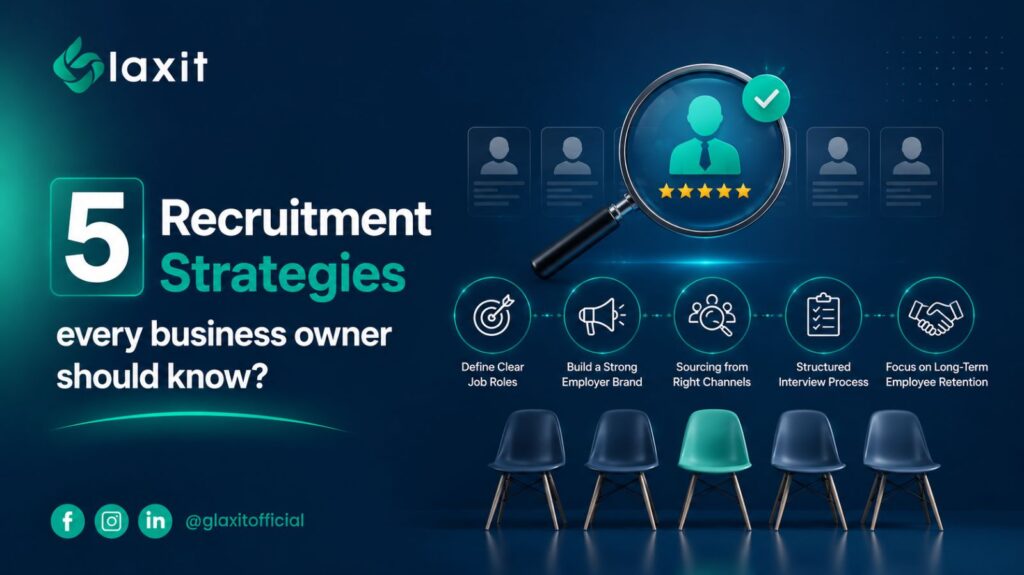
The five recruitment strategies most companies rely on are employee referrals, campus and job fair hiring, internal promotions, recruitment agencies or headhunters, and online job boards paired with social media outreach. Each method fits a different hiring need, budget, and timeline, so most HR teams mix two or three at once instead of picking just one.
Hiring is expensive when it goes wrong, and slow when it goes right without a plan. This guide breaks down what are the five recruitment strategies or methods in plain language, shows where each one works best, and points out the mistakes that quietly drain a hiring budget. It’s written for HR managers, small business owners, and startup founders who need a hiring system that actually holds up, not just a list of buzzwords.
What Are Recruitment Strategies, Exactly?
Recruitment strategies are the specific channels and tactics a company uses to find, attract, and convince candidates to apply for open roles. They sit underneath recruitment strategies in HRM, the broader field covering workforce planning, employer branding, and long-term talent pipelines. A single job opening might use three or four of these tactics at once, so anyone asking what are the recruitment strategies for a specific role should really be asking which combination fits that role.
Strategy is the plan. Method is the action. A company can have a hiring strategy built around “grow the engineering team by 20% this year” and use several recruitment strategies examples to get there, such as referrals plus a staffing agency plus targeted LinkedIn ads.
Most small businesses skip the planning step entirely. They post a job when someone quits, then scramble. That reactive pattern is exactly what a documented set of employer recruitment strategies is meant to fix, and it’s also the gap that hr recruitment strategies frameworks are built to close.
Why Do Companies Need More Than One Recruitment Method?
No single channel reaches every kind of candidate, so relying on one method almost always leaves strong applicants undiscovered. A job board might reach active job seekers, but it rarely reaches the passed-over passive candidate who isn’t scrolling listings but would jump for the right offer.
Cost-effective recruitment strategies usually combine a free or low-cost channel, like referrals, with one paid channel for volume. This spreads risk and keeps the pipeline from drying up if one source underperforms, which matters most when effective recruitment strategies and practices need to hold up during a hiring freeze or a sudden headcount cut.
What Are the Five Recruitment Strategies ?
The five core methods are employee referrals, campus recruiting, internal mobility, third-party agencies, and digital job platforms. Below is a breakdown of how each works, what it costs, and when to use it.
1. Employee Referrals
Current employees recommend people they know for open roles, often for a cash bonus. Referred candidates tend to stay longer and ramp up faster, since someone already vouched for their work style. This is one of the most cost effective recruitment strategies available, since it skips job board fees almost entirely, and it’s usually the first line item any employee recruitment strategies checklist recommends testing.
2. Campus and Job Fair Recruiting
Companies build pipelines directly with universities, trade schools, or industry job fairs. This works well for volume hiring of entry-level talent and for building a brand with future graduates years before they’re job hunting. It’s a slower burn, better suited to corporate recruitment strategies with long planning cycles than to an urgent single hire.
3. Internal Mobility and Promotions
Filling a role from inside the company, either through promotion or lateral transfer, keeps institutional knowledge in place and tends to boost morale. It’s one of the most underused job recruitment strategies, since many managers default to external hiring out of habit rather than checking who’s already on the team.
4. Recruitment Agencies and Headhunters
Outside firms handle sourcing, screening, and sometimes negotiation, usually for a fee tied to the hired candidate’s salary. This suits urgent, senior, or highly specialized roles where an internal HR team lacks the network or the bandwidth. It’s rarely the cheapest option, but it’s often the fastest, and among strategies for recruitment at the executive level, it’s still the default choice for most companies.
5. Online Job Boards and Social Media Recruiting
Posting on platforms like LinkedIn, Indeed, or niche industry boards, combined with organic or paid social media outreach, remains the highest-volume method for reaching active job seekers. Business recruitment strategies built around social media also double as employer branding, since candidates browse a company’s posts before they ever apply.
Which Recruitment Strategy Actually Works Best?
There’s no single best recruitment strategy; the right choice depends on the role’s urgency, seniority, and budget. Anyone searching for the single best recruitment strategies option is usually better served by matching the method to the role instead. The table below breaks down where each method tends to win, using real examples of recruitment strategies pulled from how mid-size companies actually staff open roles.
| Method | Best For | Typical Cost | Speed |
|---|---|---|---|
| Employee referrals | Culture fit, mid-level roles | Low | Medium |
| Campus recruiting | Entry-level, high-volume hiring | Medium | Slow |
| Internal mobility | Retention, leadership pipeline | Low | Fast |
| Agencies/headhunters | Senior, specialized, urgent roles | High | Fast |
| Job boards/social media | Broad, high-volume reach | Medium | Medium |
How Can a Business Improve Its Recruitment Strategies in 2026?
Improving hiring in 2026 means tightening the candidate experience, using data to see which channel actually converts, and treating employer brand as a recruiting asset, not an afterthought. Recruitment strategies 2026 trends lean toward shorter application processes, more AI-assisted screening, and heavier reliance on employee-generated content over polished corporate job ads.
A quick audit helps: track where each hire in the last year actually came from, then compare that against what got spent on each channel. Most companies are surprised by how much budget goes toward a source that barely produces hires, and that audit alone answers most of the “how to improve recruitment strategies” question without hiring a consultant.
New recruitment strategies worth testing this year include structured skills assessments in place of resume screening and shorter, mobile-first application forms. Successful recruitment strategies rarely change overnight; they get refined one hiring cycle at a time based on what the data actually shows.
What Makes a Recruitment Strategy Innovative or Creative?
Innovative recruitment strategies usually involve meeting candidates where they already spend time, rather than expecting them to hunt for a job posting. That might mean recruiting through Discord communities for tech roles, TikTok for Gen Z hourly workers, or skills-based hiring challenges instead of resume screening.
Creative recruitment strategies don’t need a huge budget to work. A short video from current employees describing a typical day often outperforms a paid ad, because it feels honest instead of scripted, and it’s a tactic that shows up repeatedly in recruitment strategies examples shared by fast-growing startups.
Recruiting isn’t a single tactic pulled off a shelf; it’s a mix built around the role, the timeline, and the money available. The five methods covered here, referrals, campus recruiting, internal mobility, agencies, and job boards, each solve a different piece of the hiring puzzle, and most successful HR teams run two or three in parallel rather than betting everything on one.
Nobody gets hiring right by guessing. The businesses that consistently land good people are the ones treating recruitment as a system with numbers attached, not a task that only gets attention when someone quits unexpectedly. Building that system takes a quarter or two of honest tracking, but it pays off every time a role gets filled without the usual scramble.
Frequently Asked Questions
What are the 5 main types of recruitment strategies?
The five main types are employee referrals, campus recruiting, internal mobility, third-party recruitment agencies, and online job boards combined with social media outreach. Companies typically combine at least two of these for any given hiring campaign, since each channel reaches a different pool of candidates.
What is the most cost-effective recruitment strategy?
Employee referrals are generally the most cost effective recruitment strategy, since they avoid job board fees and agency commissions while producing candidates who already have a personal connection to the company. Internal mobility is a close second, since it requires no external sourcing cost at all.
How do small businesses recruit without a big budget?
Small businesses tend to lean on referrals, local networking, and free or low-cost job boards rather than agencies. Building a simple, honest careers page and asking current staff to share openings on their own social media often outperforms paid advertising for a small team.
What is the difference between recruitment strategy and recruitment method?
A recruitment strategy is the overall plan, such as growing a department by a certain number of hires within a set budget and timeline. A recruitment method is the specific channel or tactic used to execute that plan, like posting on a job board or working with a staffing agency.
Why do employee referrals work better than job postings?
Referred candidates arrive with a built-in reference from someone who already understands the company culture, which cuts down on mismatched hires. Data from HR industry surveys has consistently shown referred employees stay longer on average and reach full productivity faster than candidates sourced through open job postings.